Imagine your website as your very best salesperson. One that is ready day and night, 24/7, to welcome and convince customers. Web copywriting The art lies in putting exactly the right words in the mouth of that digital salesperson. Words that not only inform, but also evoke a feeling and spur people into action. It is the indispensable link between a casual visitor and a loyal customer.
Why web copywriting is the engine of your online success

Many entrepreneurs still view their website as an online business card or a static brochure. This is a missed opportunity, because a strong website is so much more: it is an active engine for growth. The fuel for that engine? That is your copy. Without the right words, even the most beautiful website won't get off the ground.
Good web copywriting is therefore much more than just typing a flawless piece of text. It is a strategic mix of psychology, SEO, and brand identity. The goal is actually very simple: to create a message that truly resonates with your target audience and smoothly guides them to the next step. Whether that is a purchase, a quote request, or subscribing to your newsletter.
A partner in your growth
Hiring a professional copywriter is not an expense, but a smart investment in clarity and persuasiveness. View it not as outsourcing a task, but as the start of a partnership. A good copywriter becomes an extension of your team, someone who stands alongside you.
Such a collaboration always begins with listening. We want to understand your company, your goals, and – above all – your customers through and through. Only then can your unique story be translated into words that deliver results. This focus on smooth, transparent collaboration ensures that the end result is not only professional but also truly feels like your brand.
Strong web copy is the result of a dialogue. It is the bridge we build together: between what your company wants to say and what your customer needs to hear to be convinced.
Crucial in a competitive market
In today's online world, a clear message is no longer a luxury. Especially in Belgium, where competition is fierce. Recent figures show that 27,31T of Belgian SMEs are active in e-commerce, significantly higher than the European average of 19.1%. That means you need to stand out with texts that inspire trust and make a real connection.
A copywriting partner helps you to:
- To build trust with clear, honest communication.
- To rank higher in Google by cleverly weaving SEO principles into your texts.
- To achieve more conversions by convincing visitors of your added value.
- To save time, so that you can focus on what you are best at.
Ultimately, the goal of web copywriting is simple: to translate your business goals into words that work. It is about finding a partner who not only writes but also thinks strategically to take your online presence to the next level together. For more insights, you can also browse through our inspirational articles about online strategy.
The building blocks of persuasive web copy

Good copywriting for web Don't start writing, but listening. Long before a single word appears on the screen, we dive together into the core of your story and the world of your ideal customer. What keeps them awake at night? What do they dream of? And what doubts prevent them from making a decision?
That deep understanding is the foundation upon which every persuasive text rests. It is a journey of discovery that we undertake together. At this stage, therefore, a strong copywriter is not an external executor, but a strategic partner who thinks along with you.
Together, we dig for the essence of your brand. By asking the right questions, we help you transform your own knowledge and passion into a message that truly resonates with your audience. This interaction is crucial. It ensures that the final copy is not only technically sound but also breathes the soul of your business.
Creating an authentic connection with your tone of voice
Every brand has a personality. Are you serious and knowledgeable, or informal and a tad rebellious? That personality comes to life in your tone of voice: the unique color and sound of your communication. It is the difference between a stiff, formal email and a casual chat with a friend.
A consistent tone of voice ensures recognizability and builds trust. Customers can sense perfectly when a message is sincere. That is why it is so important to find a style that seamlessly aligns with your company culture and the expectations of your target audience.
Finding that voice is a creative process based on smooth collaboration. The copywriter acts as a mirror here, reflecting your brand's identity and capturing it in words. The goal? A writing style that feels so natural it seems as if you wrote every text yourself.
Copywriting is not a monologue, but a dialogue. It starts with an open conversation between you and your copywriter, to then initiate a conversation between your brand and your customer.
The best results are achieved when there is a connection, when we truly understand your vision. This partnership makes the entire process not only more efficient but also much more enjoyable. Collaboration is the key to copy that not only sells but also builds a lasting bond with your audience.
Guiding readers step-by-step with the AIDA model
Once the foundation – your customer knowledge and tone of voice – is solid, we can start building. A proven structure that helps with this is the AIDA model. Think of it as a blueprint that takes the reader step by step from attention to action. Let's break it down briefly:
-
Attention
The first task is simple: grab attention in a sea of online distractions. You do this with a powerful title or an opening sentence that immediately addresses a painful problem or a deep desire. Think of a question like: "Can't you find qualified staff either?"" -
Interest
Once you have their attention, you need to hold it. Here you show empathy and demonstrate that you truly understand the reader's problem. For example, you can delve deeper into the frustrations that an endless hiring process entails. -
Desire
Now it is time to bridge the gap to your solution. You create desire by painting the picture of the benefits of your product or service. So don't say "we offer recruitment services," but rather: "Just imagine your ideal candidate starting work next month." Do you feel the difference? -
Action
Finally, you need to tell the reader very concretely what the next step is. A clear, low-threshold call-to-action (CTA) removes any remaining doubt. "Schedule a no-obligation consultation today" works much better than a vague encouragement.
The AIDA model is much more than a marketing gimmick; it is a logical structure that taps into human psychology. An experienced copywriter knows exactly how to seamlessly weave these elements into your web copy, ensuring that every page becomes a smooth and persuasive journey for your visitor.
Better findability with SEO copywriting
You have a rock-solid message, a beautiful design, and copy that perfectly captures the soul of your company. But what if those carefully chosen words never reach the right people? Even the best web copy is useless if no one can find it. And that is exactly where SEO copywriting makes the difference: the art of writing for both people and search engines like Google.
Forget the idea that this is simply about stuffing a page with keywords. That is an outdated tactic that Google punishes rather than rewards these days. True SEO copywriting is a subtle interplay between creativity and strategy. The goal? To create valuable, relevant content that offers clear answers to your audience's questions.
More than just words on a page
A good SEO copywriter doesn't think like a writer, but like a strategic partner. Therefore, the collaboration doesn't start with typing the first sentence, but with listening and analyzing. What is your ideal customer really looking for? Which words and phrases do they use in their search? Thorough keyword research lays the foundation for content that perfectly aligns with what your visitor wants to know.
These insights are then seamlessly woven into the text. The key is to place the right keywords in strategic locations—think headings (H1, H2), the introduction, and the body text—without compromising readability. The text must flow naturally and, first and foremost, captivate and persuade the reader.
The image below beautifully illustrates how strong content and technical SEO optimization go hand in hand. They are the two pillars for strong online visibility.
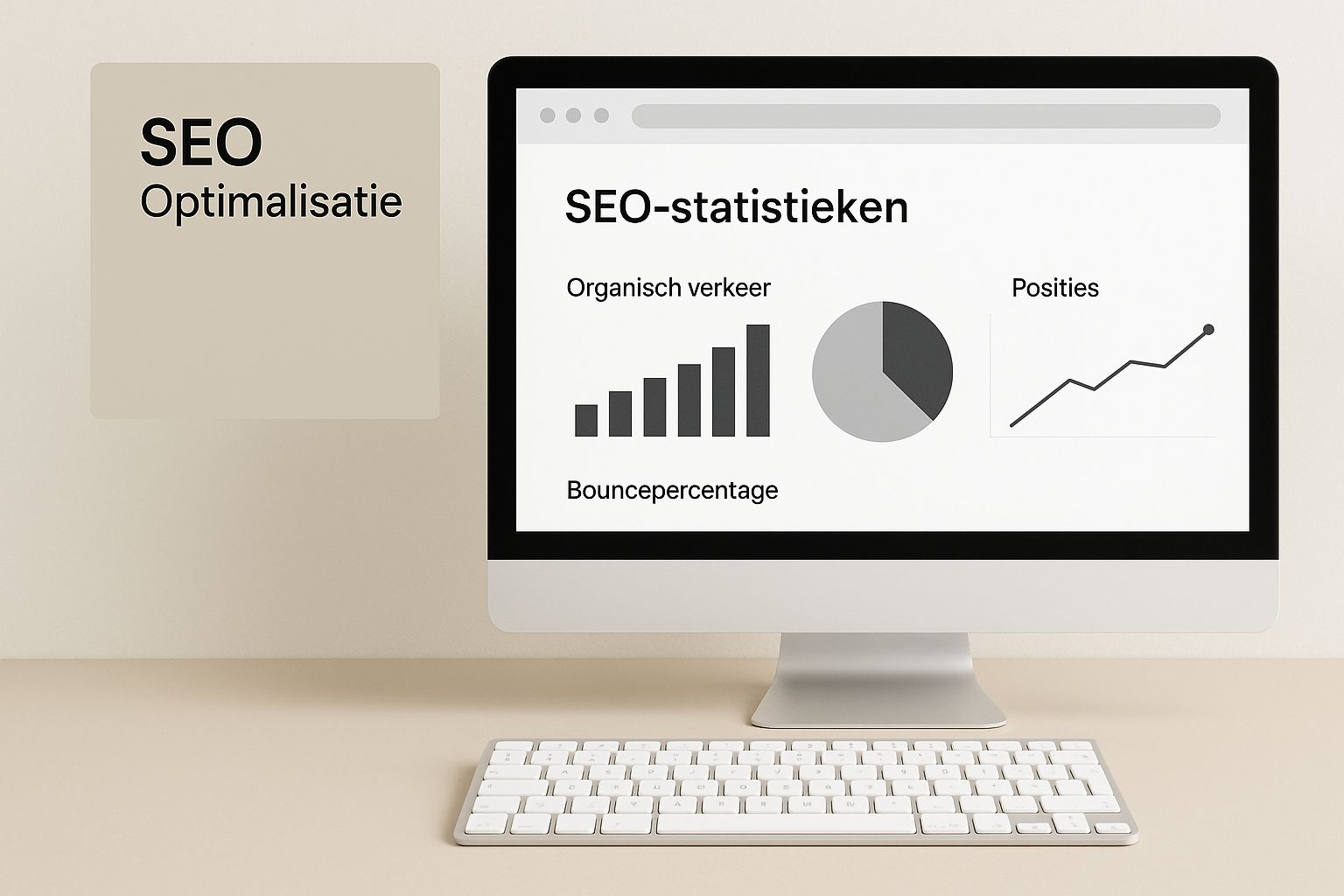
This shows that every element, from keyword to internal link, contributes to a stronger whole and therefore better performance in search engines.
The technical side of SEO copywriting
In addition to creative writing, there are also a few crucial technical aspects that can give your findability a huge boost. A professional copywriter handles these tasks effortlessly, allowing you to focus on what you do best. It is part of the service.
Some indispensable elements are:
- Meta-descriptions: This is the short text that appears below your page title in the search results. A good meta description is not only optimized for keywords, but is above all an irresistible invitation to click through.
- Internal links: By strategically linking to other relevant pages on your own website, you create a logical structure. This helps search engines understand the coherence of your content and, more importantly, keeps visitors on your site longer.
- Alt text for images: This is a short description of an image. It not only helps with accessibility (for screen readers), but also provides search engines with crucial context about what is visible in the image.
- Structure and readability: Short paragraphs, clear subheadings, and the use of bullet points make your content more pleasant for the reader and easier for Google to 'scan'.
The following table summarizes the key differences between traditional copywriting and SEO copywriting.
Comparison of traditional copywriting vs. SEO copywriting
An overview of the key differences in focus, objectives, and techniques between traditional copywriting and modern SEO copywriting.
| Feature | Traditional Copywriting | SEO Copywriting |
|---|---|---|
| Main objective | Convince the reader immediately (e.g. sales, brand awareness). | Both persuade the reader and inform the search engine. |
| Focus Audience | The human reader. | Human reader and search engine algorithms. |
| Techniques | Storytelling, psychology, brand message. | Keyword research, content structure, internal links. |
| Channels | Brochures, advertisements, emails, websites (without SEO focus). | Websites, blogs, landing pages (with an SEO focus). |
| Measurability | Conversion rate, sales figures. | Rankings, organic traffic, click-through rate, conversions. |
Although the approach differs, both disciplines complement each other perfectly. Strong SEO copywriting always contains the persuasive power of traditional copywriting.
SEO is not an end in itself, but a means to get your valuable message to the right audience. It is the bridge between a search query and the solution you offer.
You really should not underestimate the impact of high-quality, optimized content. Worldwide, no less than 69% of the marketers in SEO, with a strong emphasis on keywords (71%) and localization (50%). This demonstrates how crucial it is. Moreover, web users are 70% less inclined to click on advertisements with spelling and grammatical errors, which further underscores the importance of professional copy.
Good to know: SEO copywriting focuses on organic, unpaid visibility. This contrasts with SEA (Search Engine Advertising), where you pay for advertisements. Both can reinforce each other, but SEO is the foundation for sustainable and free traffic in the long term. Feel free to read more about the difference between SEO and SEA in our comprehensive article.
From visitor to loyal customer: the art of conversion
Getting more visitors to your website is one thing. But what you really want are more customers. As soon as your SEO efforts yield results and the right people land on your site, the next crucial phase begins: conversion. This is where web copywriting shows its true power and transforms an anonymous visitor into a paying, loyal customer.
This goes much further than simply pasting a 'Buy now' button onto your page. It is about creating a seamless and convincing experience that removes any doubt. Think of your web copy as a helpful guide that perfectly senses what questions your visitor has and answers them proactively.
The psychology behind a rock-solid call-to-action
The call-to-action (CTA) is the beating heart of every page that needs to convert. It is the moment when you explicitly ask your visitor to do something. A weak or unclear CTA can cause even the most interested reader to disengage.
An effective CTA is clear, specific, and action-oriented. Instead of a vague 'Continue' button, choose text that promises a concrete result. Consider:
- ""Download my free e-book now""
- "Schedule your no-obligation demo"
- "Start saving today"
The psychology behind this is simple: people want to know what they get when they click. By stating the value directly in the CTA, you lower the barrier and make the next step almost irresistible.
Gaining trust with social proof
Before someone decides to do business with you, they want certainty. Especially online, where the competition is just one click away. Social proof is one of the most powerful tools to turn that doubt into trust.
Potential customers don't believe what you say about yourself, but they do believe what other customers say about you. Social proof is the ultimate confirmation that you live up to your promises.
Therefore, integrate supporting elements in strategic places, such as your landing pages and product descriptions. A few examples:
- Testimonials: Short, authentic quotes from satisfied customers. Including a name and photo ensures maximum credibility.
- Reviews and ratings: Star ratings provide a quick, visual confirmation of quality.
- Case studies: Detailed success stories showing how you solved a concrete problem for a client.
- Customer logos: Do you work for well-known brands? Then display their logos. That immediately projects authority and reliability.
Social proof reassures people. It shows that others have already taken the leap and are satisfied with it, which makes the decision much easier for a new customer.
Ensure a smooth customer journey
Converting a visitor into a customer is a journey, not a standalone event. Your web copy must make that journey as smooth and logical as possible. Every page must have a clear goal and effortlessly lead the visitor to the next step. A good copywriter answers unspoken questions and removes friction before it even arises.
In concrete terms, this means that your product pages don't just list features, but primarily emphasize the benefits. It means that your landing pages have a logical flow, from a compelling headline to that persuasive CTA.
The numbers don't lie. Personalized call-to-actions can increase the chance of conversion by as much as 202% increase. In a market where 73% Since a large percentage of readers only scan blog posts, your texts must grab attention immediately and be easy to read. Discover more insights about the impact of strong copywriting on conversion.
By optimizing the customer journey, you not only increase your conversion but also improve the overall user experience. This results in satisfied customers who return more quickly and recommend your brand to others. While optimizing your content, it is also useful to understand, by the way. how you can estimate your chances of a good ranking in Google, because visibility and conversion go hand in hand. Ultimately, this leads to a measurable return on investment (ROI) that directly proves the value of professional web copywriting.
Collaborating with a copywriter: here's how to go about it
You web copywriting Outsourcing can be quite daunting. After all, you are handing over your company's voice. But don't view it as a leap into the unknown, but rather as the start of a smooth and productive collaboration. The goal is a partnership where open communication and a shared mission take center stage.
Therefore, view your copywriter not as an external supplier, but as a temporary addition to your team. Someone who fully immerses themselves in your world: your goals, your customers, and your unique story. This makes the entire process not only much more efficient, but also simply more enjoyable.
A clear process from A to Z
A structured approach creates clarity and prevents misunderstandings. Although every project is different, a professional collaboration usually follows a predictable path. This provides peace of mind and confidence, because you know exactly where you stand and what is expected of you.
A typical route looks something like this:
-
The briefing: laying the foundation together
Everything starts with a good conversation. We want to know everything about you: your 'why', the problems you solve for clients, who your competitors are, and what tone of voice suits you. A strong briefing is already 50% of work. -
Strategy and research: digging deeper
After the intake, the copywriter dives into the subject matter. He or she analyzes your target audience, conducts keyword research, and studies the market. Based on all these insights, a concrete content strategy is mapped out. -
The first version: the starting shot
The ideas are now being converted into a first draft. View this text as a solid basis for discussion, not as a finished product. It is the perfect moment to check if the tone and message feel right. -
Feedback and refinement: together to the top
Your feedback helps to further refine the text. Constructive input is invaluable here. A professional collaboration always includes one or two rounds of feedback to arrive at a final result that you fully support. -
Final delivery: ready for action
After the final adjustments, you will receive the definitive texts. Fully ready to strengthen your website and convince visitors.
Collaborate efficiently for the best result
A smooth workflow depends on clear communication and handy tools. Fortunately, there are plenty of free applications today that make collaboration much easier. Think of shared documents in Google Docs where you can leave comments directly, or project management tools such as Notion or Airtable to monitor progress.
These tools eliminate the need for endless email chains and centralize all communication and feedback. This not only saves a lot of time but also ensures that everyone is always on the same page.
The best web copy does not arise from a one-sided assignment, but from a dynamic interaction. It is a partnership in which your expertise regarding your company and the copywriter's expertise in language and psychology come together perfectly.
How do you give constructive feedback?
Giving good feedback is an art, but it doesn't have to be difficult. It helps the copywriter better grasp your vision and fine-tune the text perfectly. So always try to be as specific as possible.
A few tips:
- Focus on the message, not on the commas. Look at the big picture first. Is the tone right? Are we addressing the target audience correctly? Is the message clear? The details can wait.
- Give concrete examples. Don't just say: "I don't like this paragraph." Instead, explain why: "This paragraph feels a bit too formal. I would like to see it more personal, a bit like in our welcome message.""
- Ask questions. If something is unclear, ask for the reasoning behind it. "Why did you choose this specific call-to-action?" Such a question often leads to valuable insights.
By truly viewing the process as a collaboration, we not only build better copy but also a lasting relationship. In doing so, we lay the perfect foundation for a rock-solid online presence that helps your business grow.
Some frequently asked questions about web copywriting
The decision to hire a professional copywriter often raises some questions. This is understandable, as it concerns the voice of your company and an investment that needs to pay off. To dispel any remaining doubts, we provide honest answers to the most common questions here.
How much does a professional web copywriter cost?
Rates for a good copywriter vary widely. It all depends on the writer's experience, the complexity of the assignment, and the total scope. Some charge by the hour, others by the word, but a fixed project price usually provides the most clarity for everyone. No surprises afterwards.
But above all, don't view it as a mere cost. Look at it as an investment in your business growth. Good web copy that convinces visitors to become customers and helps you rank higher in Google quickly pays for itself.
A strong copywriter is not a supplier, but a partner who thinks along with you. The value lies not only in the words, but above all in their strategic impact on your business goals. A clear quotation is therefore the start of a good collaboration.
A professional quote always explains crystal clear what you get for your money: the exact scope, the number of feedback rounds, and a realistic timeline. This way, you know exactly where you stand and immediately build a relationship of trust.
How do I know if the new web copy is successful?
The big advantage of online marketing? You can measure almost everything. You can therefore perfectly track the success of your new web copy using concrete figures, the so-called KPIs (Key Performance Indicators).
Be sure to keep an eye on these statistics to see the impact:
- Conversion rate: This is the most important one. Are you selling more? Are you receiving more quotation requests? Or are more people subscribing to your newsletter? An increase here is pure profit.
- Time on the page: If visitors suddenly stay on a page much longer, that is a rock-solid signal. It means the content captivates them, and search engines like to see that too.
- Bounce rate: A lower bounce rate means that fewer people leave your website immediately. Your new copy therefore aligns clearly better with what they were looking for.
- Positions in Google: Track your most important keywords. Good SEO copywriting ensures that you climb higher in the search results over time.
A smart copywriter will actually help you establish these metrics right from the start. This way, you can conduct a clear before-and-after analysis afterwards and see the added value in black and white.
Why shouldn't I just write the copy for my website myself?
You naturally know your product or service like no other. That knowledge is worth its weight in gold. But that is precisely where the catch lies: the 'curse of knowledge'. Because you are so deeply immersed in it, it is incredibly difficult to put yourself in the shoes of an outsider. The result? Texts full of jargon that completely miss the mark for a potential customer.
An external copywriter brings a fresh, objective perspective. He or she is the perfect bridge between your expertise and your client's world. Moreover, a professional masters the art of persuasion and the intricacies of SEO. And that is truly a discipline in itself.
So it is not just about writing. It is a partnership that saves you valuable time and, above all, ensures that your unique story is translated into a message that customers understand, feel, and take action.
How does such a briefing and feedback process work?
Everything depends on smooth collaboration. The goal is to work together to achieve a final result that you fully support. Every copywriter has their own working method, but the general outlines are usually the same.
It's all about clear communication in a few steps:
- A thorough briefing: The starting point is always an in-depth conversation or a well-thought-out questionnaire. We zoom in on your goals, your target audience, your brand identity, and the tone you want to project.
- A first version: With all that information, the copywriter gets to work and delivers a first draft. This is the foundation upon which we build further.
- Your constructive feedback: Your input is crucial here. A good copywriter is open to feedback and sees it as an opportunity to perfectly align the text with your vision. Usually, one or two feedback rounds are provided.
- The final version: As soon as your comments have been processed, you will receive the final text. Fully ready to make your website shine.
The entire process is a collaboration. Your in-depth knowledge of your business, combined with the copywriter's expertise in writing and marketing, leads to a result that neither could have achieved alone.
Ready to discover the power of professional web copywriting for yourself? The team at Expert media is eager to translate your story into words that convert. Contact us today via https://expertmedia.be and discover what a strategic partnership can mean for your company.